How Often Should You Refinish or Reseal Your Outdoor Furniture?

How Often Should You Refinish or Reseal Your Outdoor Furniture?
You chose your outdoor furniture carefully—the material, the finish, the style — every detail considered. Yet within a season or two, something shifts. The rich teak tone fades to a weathered grey. The painted metal surface develops hairline cracks. The sealed wood loses its water-beading quality and starts absorbing moisture instead of repelling it.
This is not a product failure. It is a maintenance signal — and knowing how to read it is what separates outdoor furniture that lasts a decade from furniture that needs replacing in three years.
Refinishing and resealing are the two most powerful protective maintenance practices available to any outdoor furniture owner. Yet most homeowners either skip them entirely or apply them on the wrong schedule, using the wrong products for the wrong materials.
This guide gives you the exact framework — material by material, climate by climate — for knowing precisely when and how to refinish or reseal every piece in youroutdoor furniture collection.
How Often Should You Refinish or Reseal Your Outdoor Furniture?

Why Refinishing and Resealing Matter More Than You Think

Every outdoor furniture finish — whether it is a factory-applied sealant, an oil treatment, a painted coat, or a natural wax — functions as a sacrificial protective layer. Its job is to absorb UV radiation, repel moisture, resist mould, and take the physical impact of daily use so the underlying material does not have to.
Over time, this layer degrades. UV exposure breaks down the molecular bonds in oils and sealants. Rain and humidity penetrate microscopic surface cracks. Temperature fluctuations cause materials to expand and contract, gradually weakening protective coatings from within.
Once the protective layer fails, the underlying material becomes directly exposed. Wood begins to absorb moisture and dry unevenly, leading to cracking and splitting. Metal surfaces corrode at an accelerated rate. Natural fibers become brittle and prone to breaking.
The critical insight here is this:refinishing and resealing are not cosmetic maintenance — they are structural protection. The visual signals you see — fading, greying, chalking, peeling — are simply the surface indicators of a deeper protective failure already underway.

Refinishing vs. Resealing: Understanding the Difference

These two terms are often used interchangeably, but they describe distinct processes:
Resealing applies a new protective layer over an existing surface without altering the material's natural appearance. It is primarily a moisture- and UV-barrier renewal. Sealants, oils, and waxes fall into this category.
Refinishing involves either restoring a surface to its original condition (sanding back greyed or weathered wood, stripping old paint) or applying a new aesthetic finish (staining, repainting, re-oiling). Refinishing is more labor-intensive but is necessary when the surface has visibly degraded beyond what a fresh sealant coat can address.
Understanding which process your furniture needs at any given point is the first step in building a practical maintenance schedule.
How Often Should You Refinish or Reseal Your Outdoor Furniture?

Material-by-Material Refinishing and Resealing Schedule

🪵 Teak and Tropical Hardwood Furniture

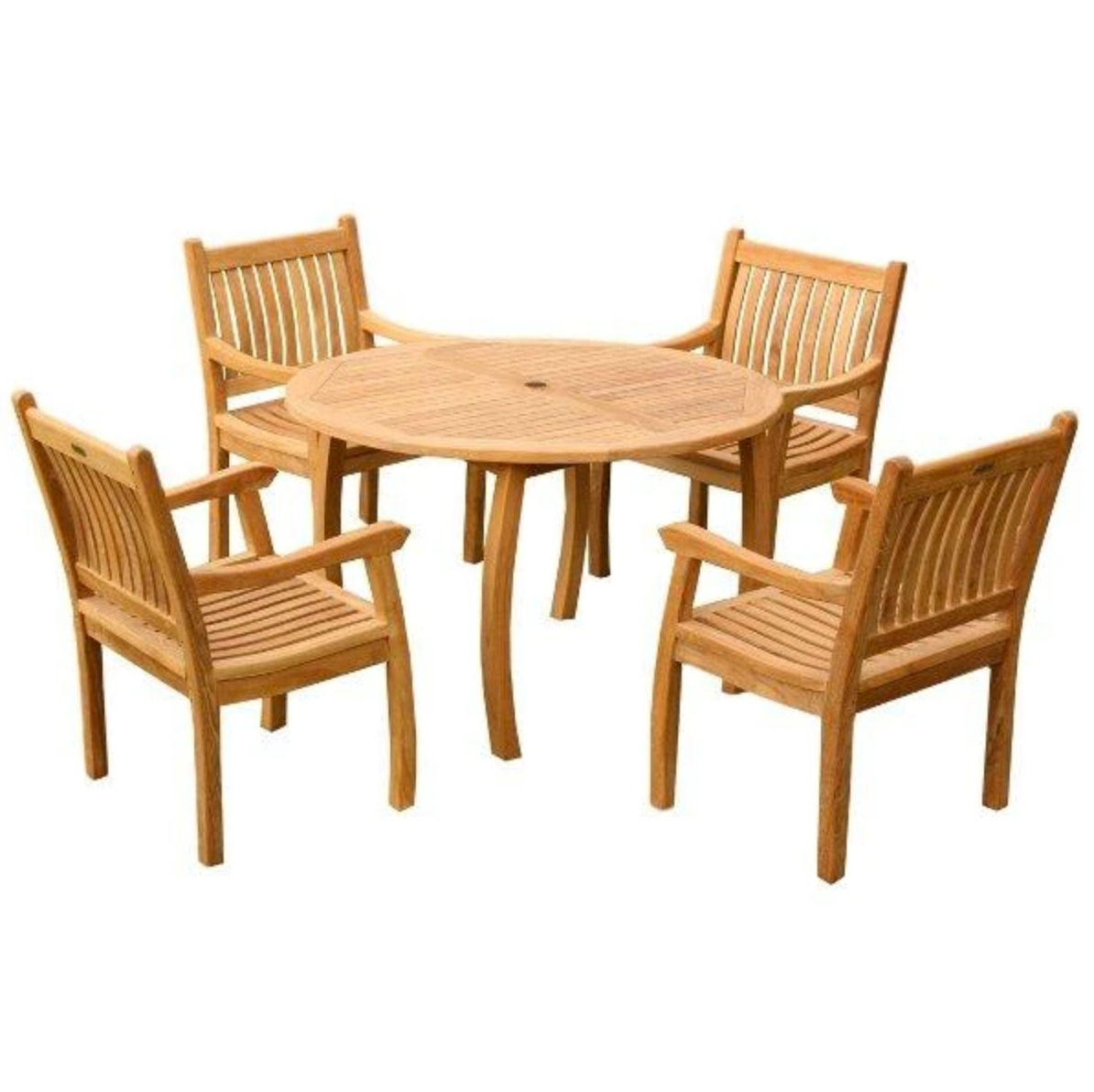
Teak is the benchmark material foroutdoor wood furniture durability — but it still requires consistent maintenance to perform at its best.
Recommended schedule:
  • Teak oil or sealant: Apply every 6–12 months depending on climate exposure
  • Full refinish (sanding + re-oiling): Every 2–3 years or when greying is significant
  • Teak brightener treatment: Before refinishing to restore original wood tone
The key indicator: Run your hand across the surface. If water no longer beads and instead soaks in within seconds, the sealant has failed, and resealing is required immediately.
In high-UV climates or coastal environments where salt air accelerates degradation, teak furniture benefits from a resealing schedule of about every 6 months. In moderate, temperate climates, an annual application is typically sufficient.
Pro tip:Always sand lightly with 220-grit sandpaper before applying fresh oil or sealant — this opens the wood grain and dramatically improves product absorption and longevity.

🎨 Painted Wood and MDF Outdoor Furniture

Painted surfaces on outdoor wood furniture require a different maintenance approach than oiled or sealed natural wood.
Recommended schedule:
  • Touch-up painting (chips, scratches, peeling edges): Every season as needed
  • Full repaint: Every 2–3 years for furniture in full sun exposure; every 3–4 years for shaded or covered pieces
Key indicators:Chalking (a powdery residue on the paint surface), peeling at edges and joints, or visible bare wood are all signs that a full repaint is overdue.
Use exterior-grade, UV-resistant paint formulated specifically for outdoor wood. Primer is non-negotiable before repainting — skipping primer is the leading cause of premature paint failure on outdoor furniture.

🔩 Wrought Iron and Steel Furniture

Metal furniture is uniquely vulnerable — once rust establishes itself, it spreads rapidly if left untreated. Maintenance here is less about resealing and more aboutactive rust prevention and paint maintenance.
Recommended schedule:
  • Wax or clear metal sealant:Every 12 months at minimum
  • Touch-up paint on rust spots:Immediately when identified — never delay
  • Full strip, rust treatment, and repaint:Every 3–5 years depending on climate exposure
Key indicator:Any visible rust — regardless of size — is an immediate action signal. A rust spot the size of a coin will spread to cover a full armrest within a single wet season if not treated.
In coastal or high-humidity environments, wrought iron furniture requires a resealing schedule every 6 months. The combination of salt air and moisture is particularly aggressive on untreated metal surfaces.

🌿 Eucalyptus and Acacia Outdoor Furniture

Eucalyptus and acacia are increasingly popularoutdoor furniture materials that offer excellent durability at a more accessible price point than teak — but they require more frequent maintenance.
Recommended schedule:
  • Hardwood oil application:Every 3–6 months during active outdoor seasons
  • Full sand and refinish: Every 1–2 years depending on exposure level
These timbers are denser than pine but more porous than teak, meaning they absorb and release moisture more readily. More frequent oiling compensates for this porosity and prevents the rapid greying and surface cracking that untreated eucalyptus and acacia develop within a single season.

🪑 Cedar and Pressure-Treated Pine

Cedar is naturally rot-resistant due to its aromatic oils — but these oils deplete faster than teak's, requiring more consistent replenishment.
Recommended schedule:
  • Penetrating wood sealer or deck oil: Every 12 months
  • Full refinish:Every 2–3 years or when surface shows significant weathering
Pressure-treated pine used in outdoor furniture and decking contains preservative chemicals that protect against rot and insects — but does not protect against UV-driven surface degradation. A UV-blocking penetrating sealant applied annually is essential to prevent the rapid greying and surface checking that untreated pine develops.
How Often Should You Refinish or Reseal Your Outdoor Furniture?

Climate Matters: Adjusting Your Schedule for Local Conditions

A maintenance schedule that works perfectly in a mild, temperate climate can be wholly inadequate in a more demanding environment. Adjust your refinishing and resealing frequency based on these climate factors:
High UV / Desert / Tropical
Reduce resealing interval by 30–50% — UV degrades finishes 2x faster
Coastal / Salt Air Exposure
Increase metal maintenance frequency significantly; inspect monthly
High Humidity / Subtropical
Prioritise mould-resistant sealants; inspect for mould every 8 weeks
Cold / Freeze-Thaw Cycles
Reseal before winter; inspect immediately after thaw for cracking
Moderate / Temperate
Follow standard schedules as outlined above

The Visual Warning Signs You Should Never Ignore

Your furniture communicates its maintenance needs clearly — if you know what to look for:
  • Water absorption instead of beading:Sealant has failed — reseal immediately
  • Greying or silvering on wood:UV oxidation has set in — brightener and refinish required
  • Chalking paint surface:UV degradation of paint binders — full repaint needed
  • Visible rust spots on metal:Immediate spot treatment required — no exceptions
  • Surface cracking or checking on wood: Moisture is entering the grain — urgent refinish needed
  • Peeling or flaking finish at joints: High-stress points failing first — treat before the damage spreads
 

Building Your Annual Outdoor Furniture Maintenance Calendar

A simple annual calendar prevents maintenance from becoming an overwhelming task:
Early Spring (Pre-Season):
  • Deep clean all furniture —Inspect all surfaces for winter damage
  • Apply fresh sealant or oil to wood pieces
  • Touch up any rust spots on metal pieces
Midsummer:
  • Light clean and inspection
  • Reapply wax or sealant to high-UV-exposure metal pieces
  • Check wood surfaces for early signs of moisture absorption
Early Autumn (Pre-Storage):
  • Full deep clean across all materials
  • Apply protective treatment before storage or covering
  • Address any surface damage identified during the season
Post-Winter (Before Use):
  • Full inspection for freeze-thaw damage
  • Sand and refinish any wood showing cracking or significant greying
  • Treat and repaint any rust that developed during winter storage


Frequently Asked Questions

Can I reseal outdoor furniture without sanding first?
For light maintenance resealing on furniture in good condition, sanding is optional. However, for any refinishing work or application of oil to visibly greyed or weathered wood, light sanding with 220-grit paper is strongly recommended. It opens the grain, removes oxidation, and dramatically improves product penetration and durability.
How do I know if my outdoor furniture needs refinishing or just resealing?
If the surface is clean and structurally sound but water is absorbed rather than beading, resealing is sufficient. If there is visible greying, peeling, cracking, or the surface feels rough and uneven to the touch, refinishing is required before any new sealant will perform effectively.
Is it worth refinishing old outdoor furniture rather than replacing it?
In most cases, yes — particularly for quality solid wood and metal pieces. Refinishing costs a fraction of replacement and can restore furniture to a near-original condition. The exception is structural damage — if joints are failing, wood is deeply cracked through the grain, or metal is structurally compromised by corrosion, replacement becomes the more cost-effective option.
What is the best sealant for teak outdoor furniture?
Penetrating teak oils and specialist marine-grade teak sealants designed specifically for tropical hardwoods perform best. Avoid film-forming varnishes on teak — they sit on top of the surface rather than penetrating the grain and peel off within a single season due to teak's naturally high oil content.

Protect What You Invested In

Your outdoor furniture does not age on its own timeline — it ages on yours. A consistent refinishing and resealing schedule, tailored to your specific materials and climate, is the single most impactful action you can take to protect your investment and extend the performance life of every piece in your collection.
The signals are always there—the greying wood, the absorbing surface, the rust spot at the joint. Respond to them early — with the right product and the right technique — and your outdoor furniture will reward you with years of reliable, beautiful performance through every season.

Also in News

Natural Cleaners vs. Commercial Cleaners: What's Best for Your Patio Set?

Rust Prevention Tips for Metal and Wrought Iron Furniture

How to Store Outdoor Furniture in the Off-Season: The Complete Guide