Your Cart is Empty

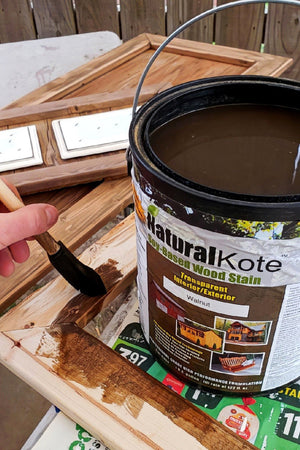

Natural Kote soy-based wood stain is the #1 choice for those that want a high quality stain that lasts. Designed and manufactured by the Amish in America.
It features almost no odor, fast tack free drying and is very scratch resistant which greatly reduces the need for touch up. It's super flowing and penetrating technology allows it to be applied via brush, roller or sprayed with little or no back brushing. It is also non-film forming which allows it to be re-coated with ease, and no need to strip for re-coats saving you a ton of time (unlike many traditional stains).
Features
Application Instructions
When staining smooth planed wood surfaces, light sanding is recommended to open the wood pores, which results in better penetration and more uniform stain color.
Apply one heavy coat applying enough so that the wood gets all that it can soak up. Take care to avoid puddling to ensure an even finish. When staining rough or sawed wood surfaces, two coats are recommended. Back brush to achieve maximum penetration of the stain.
Material: Soy-Based Wood Stain
Use: Indoors/Outdoors
Size: Quart, 1 Gallon or 5 Gallon
Colors:
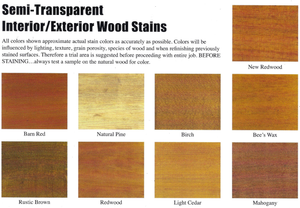
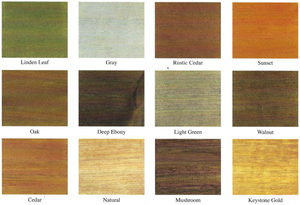
. Barn Red, Bee's Wax, Birch, Cedar, Deep Ebony, Gray, Keystone Gold, Light Cedar, Light Green, Linden Leaf, Mahogany, Mushroom, Natural, Natural Pine, New Redwood, Oak, Redwood, Rustic Brown, Rustic Cedar, Sunset, Walnut
A: The primary difference lies in the level of pigmentation and how the finish is absorbed.
Stain (Penetrating Finish): Contains minimal pigment and is designed to penetrate the wood fibers. Stain enhances the natural wood grain and texture, allowing them to remain visible. It wears away gradually through erosion and fading.
Paint (Surface Film): Is highly pigmented and forms a solid, opaque film on the surface of the wood. It completely hides the grain but offers greater resistance to moisture intrusion.
Preference: Stain is preferable when you want to showcase the natural beauty of high-quality wood (e.g., Cedar, Redwood, Teak).
A: Stains are classified by their pigment concentration, which affects their appearance and UV protection.
Clear/Toner: Contains minimal or no pigment. It primarily offers water repellency.Provides the least UV protection and typically requires annual reapplication.
Semi-Transparent: Contains enough pigment to change the wood color slightly butstill allows the grain to be clearly seen. Offers moderate UV protection and lasts 2–3 years. It is the most popular choice for decks and fences.
Solid/Opaque: Contains the highest concentration of pigment. Ithides the wood grain entirely but allows the texture to show through. It offers the best UV protection (often 4–5 years) and is used when the wood is heavily weathered or damaged.
A: Stain penetration and adherence rely entirely on the wood's dryness.
Penetration: Wood stain will not penetrate effectively if the wood is damp or saturated. The moisture fills the wood's porous cells, physically preventing the stain from being absorbed.
Moisture Meter: Ideally, the wood's moisture content should bebelow $15\%$ before staining. It is typically achieved after 2-3 sunny days following cleaning or rain. A simple "sprinkle test" (water should soak in, not bead up) can also indicate readiness.
Consequences: Applying stain to wet wood results in a blotchy, uneven finish that will quickly peel and fail, as the stain is only sitting on the surface.
A:Two light coats are almost always better than one heavy coat.
Penetration vs. Film: The stain should penetrate the wood, not form a thick film on the surface. A heavy coat creates an overly thick surface layer that can prevent the solvent from evaporating and is prone to peeling and flaking.
Application Technique: Apply stain thinly, moving in the direction of the wood grain. Wipe off any excess stain after 5–15 minutes (following product instructions) to prevent shiny, tacky patches.
Second Coat: If a second coat is desired (for deeper color or more protection), it must be applied before the first coat is fully cured, often within 12–24 hours, to allow for proper chemical bonding.